Ola! After 5 years, I've abandoned this blog. If you want more, go to boscoh.com

7.23.2005

I Can See Clearly Now, the Pain is Gone

So I bumped into H the other day, and asked a casual, "What's up?"

"Not much", she anwsered. "Well, actually, I got laser surgery on my eyes yesterday."

"Does it hurt?" I asked.

"Well no. It's remarkable, there was hardly any recovery time. I can see clearly right now."

"Wow, you must have had general anesthetic", I said.

"No. I had local."

"You were conscious through the operation?", I asked.

"Yes. Although there was no physical pain, it was gross. It's amazing, millions of years of evolution has wired us to flinch at objects that come near the eye. In the operation, I had to hold my head still, conscious, and watch someone clamp something over my iris to hold it still."

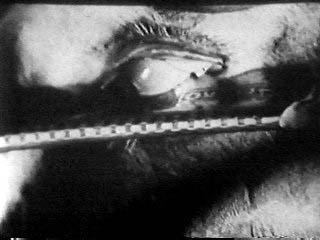
"Then the doctor brought up an electric knife up to carve open the lens. It was an electric knife but, even though I couldn't feel anything, the sound of the electric knife, which resembled a dentist's drill, was horrible. After he cut open the lens, I could feel the lid flapping in the air." [helpful image from Luis Bunuel's Le chien d'Andalou]

"What was worst was that I had been wearing my old contacts incorrectly. I would often leave them on whilst sleeping. Having the contacts in the eye for so long prevents oxygen from entering the eye. As a result my eye had grown more than its fair share of blood vessels inside the eye. My eye was engorged with blood. So when the laser started cutting open my eye, the blood vessels burst. My vision started to color red, and I could feel the blood pouring out of my eye-balls."

"You can still see the bruising," she said as she pulled away her eye-lid to show me the large splotches of bruise over the top of her eyeball.

"The operation lasted maybe 15 minutes and I felt no pain but it was one of the worst experiences of my life."

7.17.2005

The Ressurection of Angie Hart

I still remember many years ago in Australia when I first heard the voice of Angie Hart. I can't remember exactly what I was doing, but I do remember that I stopped what I was doing. The song was "Ordinary Angels", 2 minutes and 26 seconds of perfect acoustic pop. The ethereal voice of Angie Hart floated over a shuffling slightly-left-of-center chordal progression. The voice had a vulnerable, breathy quality but there was something else. Now, many years later, I realise that part of the charm of the voice is a Australian cadence, a slight flattening of the vowels and roundening of the consonants.

The song was from the band, Frente, and the song was written by the guitarist Simon Austin, still one of my favourite acoustic guitarists. They released two fantastic e.p.'s, which contained a bevy of great songs, including t"Labour of Love" (20 MB avi). The future boded well for the band, as they started to make headway into the Australian music scence. They even played at the university where I studied.

The first album, Marvin the Album, included most of the good songs from the ep's with a few new ones. Unfortunately, the first single from the album was the garish "Accidentally Kelly Street", a song with a very catchy melody but terrible lyrics (Here's the door / And here's the window / Here's the ceiling / and here's the floor), contrasting painfully with the other songs. And to pile misery onto misfortune, they made a terribly gauche music-video for the song, where Angie is dressed up in a house-wife costume cleaning a card-board cut-out house with oversized brooms and dustpans. It was a frightening possibly inspired by a session with Lucy in the Sky with Diamonds. The second album, "Shape", was where I lost interest. The problem was that Simon Austin, whilst a brilliant acoustic guitarist, couldn't really handle the electric guitar. Frente mutated from a lively acoustic band to a languid electic prog-rock guitar band. Of course, there was a relationship within the band and not long after Austin and Hart broke up, the band ended.

I lost track of them for a while but a few years later, Angie Hart popped up again with her new band, Splendid. Well it was not so much a band, but a love child. Touring with Frente, Angie met former Chilli-peppers guitarist, Jesse Tobias, and they got married, formed the band Splendid, and released an album, "Have you got a name for this."

After Frente ended, Angie moved to L.A. and Simon moved to New York. Apparently, Splendid got jerked around by the record company where they didn't even bother releasing their first album in the States. And if you crawl through the splendid web-site, you'll find that Angie spent several years trying to write music, live in l.a., maintain a relationship, whilst working a 9-to-5 job in retail. But it seems that phase is over. Although Splendid has released their second album, Angie is now back in Australia. And Frente, well, recognizing the spark that made them great, Angie and Simon recently started playing again, and recognizing the error of their ways (mp3) , they have now reformed Frente. Long live Frente.

7.14.2005

The Nature of Rock and Roll

Stephen Metcalf, in his review of Nick Hornby's new book, penned this remarkable insight:

Nick Hornby has built his admirable career, as comedian of manners for the album rock era, out of a single, hedgehoglike insight: The majority of people touched by rock music weren't makers of rock music. In fact, they weren't even remotely like the makers of rock music. They were consumers of rock music, or dorky suburban boys in poster-filled bedrooms.
People who love rock music are people who see refracted in the rock idols, the sublimation of their desires, which for the briefest of moments, lifts them out of their (typically) middle-class homogenity. Or, as Stephen Metcalf puts it:
Sublime banality and self-centered mediocrity and a pitiful moonlit pining: Hornby captured perfectly the voice of the Baby Boomer more or less permanently fixed to the emotional vocabulary of his own pubescence.

7.07.2005

The Power of Wikipedia

It is 10:17am Western Pacific US time, Wednesday, July 7th. Already, there is a detailed entry on wikipedia on the London Bombings that happened yesterday. Reading some of the forum responses, it seems that people are inching to undestand what it may be like to have a brutal occupying power run by soldiers with frighteningly powerful guns and bombs who speak another language, and who have slaughtered over 100,000 of your countrymen.

5.30.2005

Guitar Etiquette

When at a party, chances are, someone will bring out a guitar. A guitar in a party is a magnet that sucks out guitar players from the mass of party-goers.

Typically, the owner of guitar will play a few songs, songs that he (or she) has practised for many hours in the privacy of his own room and is therefore comfortable playing in public. Like moths to the flame, guitar players in room will be drawn to the guitar, motivated by a combination of fascination with live music, but more importantly, positioning themselves for a crack of the guitar after the song is finished.

Guitar etiquette says the person who owns the guitar (Owner) must share the guitar with the other players (Guest).

"Wanna play?" asks Owner to Guest. Guest can accept or decline. Here are the rules.

If Guest is significantly inferior to Owner, Guest must decline the invitation.

If Guest feels on a par with the Owner, then Guest can accept the invitation and play one song. Then what follows will be an alternation between Guest and Owner, as they "trade" favourite songs, licks, and tricks, wowing the audience (hopefully) in the process.

If Guest is better than Owner then Guest is allowed to play several songs in a row, demonstrating Guest's superiority. Owner will then say, "Can you show me a few tricks," to which Guest is obliged to show at least one trick that Owner can learn. Then Guest owns the guitar for the rest of the night.

But if Guest is many times better than Owner, Guest will generally decline invitation to play.

Because, after all, when Owner asks "wanna play?", Owner is really asking "are you better than me?"

5.27.2005

Farewell HuaFeng Xu

One of my colleagues in the lab is leaving and I am sad. Huafeng Xu (HFX) a.k.a. Chinese Blade a.k.a. Eye of the Blade a.k.a. the Jewish-Asian magician David McKowski has decided to bid farewell to academic science on the West Coast for the pulsating glories of commerical research on the East Coast.

Oh, and his future-wife-to-be is also waiting for him there as well.

HFX, I am afraid to say, is a die-hard romantic. This was not evident at first, but he left clues. I stumbled on the first clue in, of all places, his PhD thesis. Normally, a thesis is a grindingly boring piece of prose that budding scientists are required to do. It is no joy to write. The only real emotion in a thesis is normally found in the preface/acknowledgements - I vented a few of my frustations in a page long diatribe. Not HFX. His preface was a five-page effusive outpouring of scientific romance,

"...my mental image of a theoretical chemist was a solitary figure walking down the Long Island Beach with his advisor. They would exchange a few words now and then, or squat to write some esoteric mathematical equations on the sand with their fingers. Theoretical chemistry seemed too romantic to be for me..."

Reminds me of the story about the Christian walking along the beach. Looking back, he sees that for most of the journey, there are two sets of footprints faintly impressed upon the sand - his and the Lord's. But then the Christian notices that occasionally there was only one set of prints. "Why," he asked the Lord, "did you abandon me?" "No, my son," replied the Lord, "when there was only one set of footprints, it was I who was carrying you." Think of that story as an allegory for the many conversations that I had with HFX in our journey to the truth. Sometimes only one of us would be right, then there would only be one set of footprints in the sand, as one of us would carry the weight of the error of the other. Man, does HFX like to talk. We talked about everything, the meaning of life, love under communism, the future of business in a melt-down world, chinese poetry, ethical dilemnas involving members of one's own family, the meaning of the second order pertubation expansion in the Schrodinger equation, the symbolic order behind a glass of wine in Sideways. But his is always a generous and expansive conversation, and more-often-than-not, funny as hell.

HFX has the face of an innocent child but the heart of a prankster. One of our favourite activites would be to draw cartoons in the middle of a seminar with a visiting professor and try to make the other crack up. We would write pseudo officious pronoucements that would be irresistibly funny to us but (apparently) not to anyone else. But over the last year, I saw HFX flex his writing muscles, transmorgifying his writing into something substantial. HFX reinvented himself as the blogger chineseblade, a trenchant social critic and a witty commentator of the world around him.

Talk about flexing muscles, I cannot fail to mention the time that a bunch of us, staying late at night on a Friday, decided to do a fashion parade down the catwalk of our work cubicles. One by one, we would play a song on Banu's laptop, and slither down our imaginary catwalk, strutting our stuff. When it was HFX's turn, he disappeared for a good 5 minutes before appearing in King's oversized leather jacket. He glided down the catwalk like a panther, and when he reached the end, with a well-practised motion, he whipped off the jacket to reveal his naked torso.

Many a dull afternoon at work was enlivened by an impromptu card trick from HFX. The tricks got better and better such that one night, we organized a private show. Of course, a magician cannot use his everyday persona, he must draw something from the world of fanatasy, and so the persona of David McKowski, a chinese-jew was born - son of a hasidic master of magic, refugee from Nazi Germany, who forms an illicit relationship with a simple chinese peasant girl. Growing up, Mckowski discovers his mystical roots, and learns to manipulate cards, eventually fulfiling his destiny as a Magician.

And so, I end this post, my farewell gift to you, HFX. Adieu.

4.30.2005

First glimpse of another planet

Sure astronomers believe other planets exist. But finally, someone has managed to photograph one. A bunch of international astronomers, working at the Very Large Telescope (it's a real name) at the European Southern Observatory in the Atacama Desert in Chile, thinks they've photographed the very first planet outside our solar system:


The red spot is the planet, a giant that is four times bigger than Jupiter. As they say an image is worth a thousand words, an optical photograph is worth a thousand spectroscopic radiation analyses. The sun, dubbed 2MASSWJ1207334-393254 or "2M1207" to his friends, is a small brown-dwarf, a sun that failed to light up properly. According to spectroscopic analysis, water is found on the planet, a sure sign that it is cool and planet-like.

4.15.2005

I'll borrow that for a dollar

Open source software is free, right?

Public libraries are also free, right?

Then how hard would it be to give out open-source software in public libraries?

Well it turns out to be much harder than expected. Librarians deal with all sorts of issues in accepting things for a library. Being free is only one of many complex considerations that librarians consider. In this article, Bob Kerr shows how to mediate the interests of the open-source advocate and the public librarian.

I am now closer to understanding the American Mind

America, "we are one (warning:audio)" !

4.14.2005

The Wolf is really the friend of Tree

Ecology is a rather young science, being more the province of the leisurely hiker than the hard-nosed sceptic. Often ecological writings are wishy-washy and vague. In contrast, this Scientific American article recounts a very specific and surprising example of the impact of a single species on a particular ecology. William J. Ripple, professor of botany at Oregon State University, has been studying the reintroduction of wolves into Yellowstone National Park.

In Yellowstone, the last wolf died out in the 1920's, which lead to the overpopulation of the elk population in Yellowstone. The engorged elk population exerted a severe pressure on the ecosystem. In 1995, to control the elk population, wolves from Canada were reintroduced back into Yellowstone.

As expected, the wolves quickly reduced the elk population. What was not expected was that the trees would come back just as quickly.

Elks, when they do not have to worry about wolves, are indiscriminate eaters, happy to munch on any vegetation they can find. Scared elks graze differently. Instead of dining lazily on delicate river-side vegatation in the Lamar Valley, scared elks must dine on higher ground where they can keep a look-out for wolves - wolves that smack their lusty lips at the thought of elk-meat.

During the 1920's, when the elks could eat indisriminately, magnificent trees, such as aspens and cottonwoods, stopped regenerating. Without the wolves running around in the park, when the elks got the pick of young juicy treelings. But now that the wolves back in town, the elks can't eat just anywhere, they have to watch their back like mafia gangsters dining on pasta in their favourite diner in Little Italy. The elks have to avoid exposed areas, the areas that treelings like to spread their leaves to grow.

Thanks to the wolves, young aspens and cottonwoods trees are sprouting all over the Lamar Valley again. And so, the moral of the story is: discriminate meat-eating is the best possible thing you could do to save the trees.

Offices that squeeze your Creative Juice

Joel Spolsky has his list of desiderata for programming office-space. And so does IBM (pdf).

Publishing Contract Land Mines

Dave Taylor provides a fascinating interpretation of clauses in publishing contracts.

Tourniqueting the financial bleeding at the NIH

After much gnashing of teeth, the mighty National Institute of Health has seen the light, and made open access an official requirement of NIH-funded research.

"Beginning May 2, 2005, NIH-funded investigators are requested to submit to PubMed Central (PMC) an electronic version of the author’s final manuscript upon acceptance for publication, resulting from research supported in whole or in part, with direct costs from NIH. The author’s final manuscript is defined as the final version accepted for journal publication, and includes all modifications from the publishing peer review process."
Not one minute too soon. For too long, scientific publishers, like Elsevier CEO Crispin Davis, have been leeching their 30% net profit from the scientific comuunity (compare that to the 5-10% in the rest of the publishing industry). Crispin Davis paid his dues in companies such as Proctor & Gamble, Guinness and Aegis, a midsize European buyer of ad space, where he, no doubt, learnt the values of publicly-funded research. The financial value that is.

They walk amongst us


They walk amongst us, deadly but silent.
They are frightening.
They are Zogg!!

More Classic Science Done on Rats

Will they ever stop? Andersen et. co. were not satisfied with tormenting young rats with cocaine and sleep-deprivation in order to see how that affects their ability to get-it-up, now they want to find out the same in old rats...


Does paradoxical sleep deprivation and cocaine induce penile erection and ejaculation in old rats? [link]
Andersen ML, Bignotto M, Machado RB, Tufik S
Addict Biol. 2002 Jul ; 7(3): 285-90

"To discover whether the same effects occurred in old animals ..."

"...we administered cocaine (15 mg/kg) to young (3-month) and old (22-month) male rats after a 4-day period of PSD [paradoxical sleep deprivation] ..."

"...we then evaluated erections and ejaculations."

"...in conclusion, our results suggest that although genital reflexes usually decrease with age, testosterone levels alone cannot account for these changes..."

4.06.2005

Stitch n'Bitch: The Many Ways of Joining Strings in Python

Oliver Crow has written an interesting analysis of the many different ways of stitching strings together in Python. The benchmark results are rather surprising.

4.04.2005

How many letters can fit on the head of a pin?

Everything and more on topics like: the optimal size of fonts for reading; or how many letters should fit on the width of a line.

Wolfowitz removes the fig leaf

George Monbiot, one of the most insightful writers of the left has argued that the appointment of the neocon hawk Wolfowitz to the head of the World Bank, is, in fact, the best thing to happen for progressive causes. Monbiot argues that the World Bank, has never in its history, promoted human development in the third world.

The World Bank has always been a tool of US economic unilaterism, where the US power of veto makes a gimp out of the World Bank, a fact that is "clevely packaged to grant other nations just enough slack to prevent them from fighting it." This is something that the neocons are too stupid to understand, and thus, by appointing Wolfitz, the neocons are replacing "a hegemonic system that is enduring and effective with one that is untested and (because other nations must fight it) unstable." Great read.

Hispanic high-school kids kicks MIT's ass

This is a true story of how 4 hispanic high-school kids from Phoenix kicked the ass of M.I.T. in the recent Navy underwater bot competition. If there is any PG-13 story begging to be made into a film, this is it. Hey, you could bring back James Olmos and make Stand and Deliver II. But the story doesn't end yet: as the kids are undocumented, they're not eligible for state scholarship subsidies. Any one of these kids would be worth 100 trust-fund kiddies in the american university system. But hey, we all know that equal "opportunities" is a convenient fiction.

Iranian policewomen action

Puts a whole new meaning to caped crusader fights crime. Move over spiderman. Follow the advice of the Iranian newsreader, "the policewomen are very serious. Take a look"

4.02.2005

Testestorene in Sport can make you Blind

In this week's game in the English football Premiership between Newcastle and Aston Villa, Newcastle got three players sent off. Now you might think Aston Villa were being provacatively aggressive, but no, as you can see:


Look how an Aston Villa player is bravely trying to pry apart the two feuding Newcastle players.

3.31.2005

the chinglish files

I, for one am all in favor of cross-cultural pollination, but not at the expense of the purity of the english language, as in these superb examples of chinglish.

3.30.2005

It's official, Australia is Asian

Well, not exactly, but the big news in the world of Australian soccer is that the Asian Football Federation has formally invited Australia to wean themselves away from the puny Oceania Football Federation to join the much larger Asian Football Federation.

Normally the province of painters and poets, in this case, it's soccer players who are the harbringers of change. And the future is Asian.

Of course, Australia joining Asia is only the latest episode in the entertaining sideshow Australia gets jerked around by FIFA. But it's precisely because geographically, Australia is located awkardly between the America and Asia, that Australian sport can be jerked around. It's not that FIFA is blind to geo-politics: Israel plays in the European Federation, whereas the rest of the Middle East play in the Asian Football Federation.

In previous years, for Australia to make it into the World Cup tournament, it would have to win the Oceania Federation - in which the only decent opponent is New Zealand - and then Austalia would have to beat the fifth placed South American team. Beating a South American team is always a daunting prospect as South America has produced some of the greatest players ever, Pele, Ronaldo, Romario, Maradona. North America and Asia players do not inspire nearly as much fear.

Over the last few years, the qualification to the World Cup has been a roller-coaster of capricious changes. For the 98 World Cup in France, FIFA changed the rules to help Australia where Australia had to beat the fifth-based Asian team on a wild-card to get in. Australia got so close, leading 2-0 in the penultimate match, only for the plucky Iranians to squeak in 2 goals in the last 20 minutes. But then for the 2002 World Cup in South Korea and Japan, Australia got put back into South America, as FIFA had to make room for both South Korea and Japan, thereby reducing the number of places for Asian teams. Australian officials then tried to get an automatic qualification for Oceania. This was accepted by Fifa but then immediately rejected, and rightly so, because the entire population of Oceania barely fits into a province in Brazil.

It's not that Australia lacks talent, players like Harry Kewell, Mark Viduka, and Tim Cahill ply their trade in the upper-echelons of European club soccer. But it's hard to imagine these Premiership millionares getting worked up to swat past the amateur players that some of the Oceania nations offer. Now with the tough new Asian teams (South Korea and Asia), Australian super-stars can look forward to qualifying games that will truly test their steel. If they do qualify, it would be due to a steady accumulation of points and not to a sudden-death Russian roulette with the fifth-placed South American team.

So Australian soccer officials finally saw the light that Australia's future is with Asia, an Asia that welcomes us with open arms. Unfortunately, it is a light that our current Prime Mininster John Howard, in his racist myopia, cannot see - that Australia is the gateway, the door, the doorman for the West to the East. This is something that the previous prime minister, the reviled but neverthteless visionary Paul Keating, clearly understood. Under Paul Keating, the Australian government had started to tilt its cultural axis towards Asia - promoting business and cultural exchanges, bringing in the high-flying Asian tourists, and more imporatantly, implementing educational policies such as requiring all high-school students to learn one asian language.

All this has been reversed under the Howard government. Australians are now pasty yes-men to Americans, immigration policies are used to create fear of anyone non-anglo-american. If Australian soccer followed this strategy, they would be playing stodgy defensive football, with the only attacking option being a hopeful long ball lobbed over the midfield. To its credit, Australian soccer can now play entertaining football, passing its way through the midfield, and finishing with aplomb. Such confidence has allowed Australia Soccer to stake its claim in Asia. And if this is a sign to come, the rest of Australia will surely follow.

3.27.2005

Evolution of a Wiki-Article

This is really quite a fascinating analysis (includes audio track) by Jon Udell on collabrative writing as applied to the wikipedia entry on the Heavy Metal Umlat. It covers a diverse range of topics including letter encoding in html, article vandalism, and cultural mores. It is also a neat mix of slides, audio commentary, and timely mouse pointing - a rather useful blueprint for online seminars.

3.25.2005

Rearranging Tori Amos

I have the power! The power to erase filler from albums. Thanks to the power of iTunes, I can trim the fat from a cheap-cut album and get a muscular collection of songs - slicing away until I end up with the album that I would have wanted to listen to.

Why, you might ask, would I even buy albums that I don't want to listen from beginning to the bitter end? Loyalty.

There is a period in your life, around early adolescence, where your mind is plastic and your tastes embryonic. Whatever happens to lodge itself into the little space between your eyes will quickly ossify and exert an undue influence on the listening habits of the rest of your life. (Of course, a few exceptional individuals have fresh ears their whole lives and include many music critics and sycohpahnts).

One of my idols is the tremendously talented tiny bundle of vocal histrionics, the one and only Tori Amos. All the way back in 1992, I stumbled onto her album, "Little Earthquakes" and quickly fell in luurvee. Heartbreak, poetry, gorgeous melodies, ethereal harmonies, and a very wry sense of humour packaged in, what is for me, an almost perfect album. Alas, it's been downhill ever since. It's not that she lost her ability to write great music, or her facility for language. It's just that somewhere along the way, Tori decided to produce her own material. You can definitely hear the learning-pains in "Boys for Pele" where the production veers from the harshly underproduced to songs that were bewilderingly over-layered. Compare that to the almost perfect production in "Little Earthquakes", which were produced by some real old-hands. But sonic-wise, she has always had a firm grasp of the sublime - evidence her experiments with the harpsicord and electronica.

Her main problem is that without someone else as producer, there isn't anyone else who is in a position to say, "huh! what the f*#uck are you yakking on about????" Maybe her writing is simply dense poetry. Yes, great poetry is similar in many respects to great lyrics, but there is one important difference. Poetry is written, and the speed of comprehension can be slowed right down to a single crawling word. Lyrics, on the other hand, must flow to the music. You cannot afford Joycean levels of overreading in lyrics. Besides, the words just plain don't make sense. So without some other control freak in the mixing room, what you get is stream-of-consciousness pomo ramblings that lack emotional omph.

Evidence? "The Beekeeper", the latest offering from Tori, is a case in point. According to Tori, a hexagonal garden theme is the underlying structure to the latest album "The Beekeeper". Knowing this adds absolutely no insight to the songs, it even detracts from my joy from finding my own interpretative line through the album. Standing at a good 80 minutes, it is a chore to listen-to straight through. Listening to music is meant to be joy-ride, not a punishing pilgrimmage. And so, after a few listens, I gleefully deleted all the songs that made my eyelids droop. No, I do not want to hear about Tori's Saab roaring through Ireland. No I don't have to suffer through the cringe-worthy pun "Original Sin-sinuality".

So I merrily zapped away, and I cut the album down to a very listenable 30 minutes of music. And listening to the revised album, I am reminded that when all-is-said-and-done, Tori is still an amazing musician. Buried in the middle of "The Beekeeper" is the heart-breaking "Ribbons Undone", surely one of the most beautiful paens written by a mother for her daughter. It is a slow balland, effortlessly, capturing a fleeting moment of motherhood.

Listening to "Ribbons Undone", I couldn't help but think of "Winter", a song on "Little Earthquakes". "Winter" is still one of her most poignant songs, a song about the emotional bond between a girl on her father. And I couldn't help but notice how the two songs bookend the 15 year transformation from the wide-eyed girl of "Winter" to the wordly mother of "Ribbons Undone". It is for moments such as these that rewards the musical devotion of all these years.

3.24.2005

Boltzmann in JavaLand

I found this rather impressive java applet that simulates a box of bouncing balls. This java applet makes it easy to picture how the Second Law of Thermodynamics works.

The Second Law of Thermodynamics was the master-work of the great 19th centur physicist, Ludwig Boltzmann. Boltzmann gazed into the heart of the Second Law of Thermodynamics and found statistics. Then he rephrased the Second Law of Thermodynamics in terms of statistics: the probability of the system increases until it reaches the maximum probability.

What does that mean for our box of balls? Since thermodynamics deal with energies, it turns out that the speed of a ball is a great proxy for its' energy. So for a slice of time, you can count how often any of the balls has a certain speed. And so the probability of a box of balls can be understood as the distribution of speeds of the balls. This distribution is the probability that Boltzmann is getting at.

So the Second Law of Thermodynamics for a box of balls means that (1) there is an ultimate distribution of speeds, which we call the "equilibrium distribution" (the formula for this was derived by James Clerk Maxwell), and (2) any collection of balls will collide and mix-up their speeds until the distribution of speeds reaches this equilibrium distribution, after which no matter how the balls collide further, the distribution will not really change any more.

In this java applet, you can see how distribution of speeds change over time, as the balls do their thing and collide. Be sure you play around with the "parameters" - reduce the number of balls and bump up the radius of the balls. See how the Second Law works as the distribution of speeds changes inexorably towards the equilibrium distribution, even for a few balls.

Open access is spreading

The sprawling publications of the American Chemical Society, which encompasses 33 peer-reviewd journals, will now be submited to public-accessible archives after 1 year of publication. It seems only fair that all not-for-profit organizations to do the same. We will see.

3.23.2005

Jazz Flash Animation

Micheal Levy animates: vector block graphics meets John Coltrane.

3.19.2005

Classic Science Papers

Boldy advancing rat science, where no rat has gone before...

Hormone treatment facilitates penile erection in castrated rats after sleep deprivation and cocaine.
Andersen ML, Bignotto M, Tufik S.
Universidade Federal de Sao Paulo, Sao Paulo, Brazil.
J Neuroendocrinol (2004) Feb;16(2):154-9.[link]


"...we conducted two experiments to determine whether sleep deprivation and cocaine administration could also induce spontaneous penile erection in castrated rats ...

"...these data show that progesterone treatment facilitates penile erection in sleep deprived-cocaine castrated rats."

Classic Science Papers

I was told about this fantastic paper by a fellow grad student many years ago. I thought I'd lost the reference, but I found it again:

Lysergic acid diethylamide: its effects on a male Asiatic elephant
by West, L. J., Pierce, C. M. & Thomas, W. D.
Science (1962) 138:1100-1104.

In this article, they found that a single, intramuscular dose of 297 mg of LSD caused sudden death in an elephant tested in Lincoln Park Zoo, Oklahoma City.

3.18.2005

Scientific Self-abnegation

This story has recently been doing the rounds in my postdoc circle.

"Don't become a scientist," advises physics professor Jonathan Katz from Washington University, St. Louis, in a polemic op-ed piece for brash-young would-be scientists. It was written in 1999 but if anything, is even more relevant with the diminishing science budget of the United States. He's voicing a lot of things that we postdocs have been muttering amongst ourselves.

Essentially, "American universities train roughly twice as many Ph.D.s as there are jobs for them." And using elementary economics, Katz shows how the labor "glut of scientists" has completely changed the career path of scientists, from what it was 30 years ago when Katz started. Now the postdoc stage is greatly prolonged, frequently up to 10 years, as opposed to the 2 years that Katz did. And how did this happen? The glut was due to "funding policies (almost all graduate education is paid for by federal grants)... [where] ...for many years the NSF propagated a dishonest prediction of a coming shortage of scientists".

I recently brought up this article with a colleague of mine, a visiting professor. He was much annoyed by the article. "A scientist," he said, "A true scientist is not swayed by external factors. Science is a calling." Although I liked his idealism, I feel a human being cannot be shovelled into one definition, whether it be scientist, or doctor, or builder. It's important to keep the rest of your life in view.

Like family, for instance. Katz points out that it's normal for a would-be scientist to be a post-doc for up to 10 years. And as a post-doc in your thirties, Katz asks if you "can support a family on that [postdoc] income?" One postdoc in my lab is leaving science because he wants to start a family.

Regardless, the article should make any postdoc wake-up and smell the (probably instant) coffee.

3.16.2005

Art Lesson


Punk'd refers to the MTV show where a bunch of skaters go around performing practical jokes on celebrities. The pranksters reveal their hoax by yelling out "Punk'd" to the victim.

The painting depicts the scene where the Lord sends an angel to tell Abraham that he'd been punk'd. Background: the Lord had ordered Abraham, the Lord's humble and most valued servant, to kill Isaac, Abraham's only beloved son. The very son that Abraham had to wait till his 60's before the Lord gave him strong fertile sperm to impregnate his wife Sarah.

This scene was painted by Caravagio, and is one of the most powerfully composed pieces of drama of the late renaissance. The unity of movement from left to right, as we see the angel staying the hand of Abraham that is holding the knife, moves the eye towards the writhing face of Isaac. As per usual, Caravagio models all three bodies perfectly, and the light unifies the scene. Although the light seems to be of an interior quality.

3.15.2005

The Homeless

When I walk the streets and a homeless-looking person approaches me, I normally try to politely avoid them. Sometimes I am walking with someone else, and that someone else might make a comment about the homeless. But the more I think about it the more I realise that I don't anything about them and so, this extract from Alexander Masters book was very revealing.

I Could've Been a Contender

The Times Higher Education Supplement (THES) has published a list of the world's best universities . It is gratifying that I did ugrad+grad at #36 and now I postdoc at #20.

This is how THES ranked the universities:

"Universities were placed in the table with the help of findings from a survey for the THES of 1,300 academics in 88 countries. They were asked to name the best institutions in the fields that they felt knowledgeable about."

"The table also included data on the amount of cited research produced by faculty members as an indicator of intellectual vitality, the ratio of faculty to student numbers and a university's success in attracting foreign students and internationally renowned academics in the global market for education. The five factors were weighted and transformed against a scale that gave the top university 1,000 points and ranked everyone else as a proportion of that score."

If you haven't guessed, Harvard, with an annual operating budget of over 2 billion dollars and more than most third-world nations, is at position #1.

3.14.2005

Science Pays, For Journal Publishers

The enormous Wellcome Trust has finally knuckled down and produced a report on the viability of scientific publishing as we know it. They should know, since they pay for much of it.

What does the Wellcome Trust conclude? They conclude that "the current market structure does not operate in the long-term interests of the research community" Ouch. And that "the ‘public good’ element of scientific work means market solutions are inefficient." Double Ouch.

Now you might think this is a question of sour grapes because allegedly, the origin of the report occured when the Director of the Wellcome Trust was told about a breakthrough article written by one of the Wellcome investigators scientists working in Africa. But when he went to look the article up on-line, he was greeted instead with a "you are not subscribed to our journal". This is the director of one of the biggest medical funding bodies in the world, and he funded the research.

Nevertheless, this report is a solid piece of investigation into the scientific publishing industry. There is some excellent muckracking. For instance,on describing the business tactics of the largest science publisher Elsevier, the report attributed the Elsevier business strategy to the CEO Crispin Davis, who, the report quotes "was recently described in Forbes magazine as 'an unlikely choice [for Elsevier CEO]. Davis had previously worked for Proctor & Gamble, mostly in Cincinnati, Ohio, before messing up at Guinness, then resurrecting his reputation at Aegis, a midsize European buyer of ad space.' " That's really solid publishing credentials.

The report gives a sobering analysis of the supply-demand economics of science-publishing and shows how there is no feed-back loop, because the buyers of the journals (mostly libraries) are not the readers of the journals (the scientists). This makes it ripe for monopolistic manipulation. Yearly increases in journal prices (30% in 1999) exceed the rate of inflation. And the profit margins, sometimes up to 30% is sweet-as. Science is a public endeavour, a social good paid for federal funds. And as scuh, the largesse of the huge conglomerated publishing houses flows directly from the pocket of the american tax-payer.

3.06.2005

Battlestar Galactica

Let me say that I hate Sci-Fi on TV. I never used to, but I do. There. I've said it. It seems wrong to do science and not luurve sci-fi, but dramatic conflict, rich characterizations and layered dialogue are rarely found in space ships zooming around in space on TV. Until now.

The new Battlestar Galactica has somehow slipped through the cracks, giving us a superbly written sci-fi series. It is a 'reimagining' of the original series, or in this case, throwing out all the camp. Of course, this is anaethema to the fans of the original series. They see high camp as nobility, the lack of real dark human emotions as up-lifting, speechifying dialogue as lofty classical theatre. Oh how wrong!

I have this theory that sci-fi is bad because it used to mainly appeal to adolescent teen-age boy and so the writing has to reflect their level of consciousness. It is the age where fine ideals are imagined, with a tinge of mythological self-importance. Complexity on the individual is non-existent and everything is seen in terms of epic battles between the forces of good and evil. Great for blockbuster movies, bad for TV.

But in the new Battlestar Galactica, people die. Characters betray other characters, and they die. There is real gut-wrenching fear and damnit if the directors don't milk the end-of-the-world for every compulsive moment. Pretty adolesent aesthetics be damned. People have sex, want it, get it, fail to get it, and do very bad things to get it. These are issues that used to be too painful to show as your typical sci-fi fan was emotionally underdeveloped to see it.

The sets in Battlestar Galactica do not look like toys that you can buy at Toys R Us. It is not an extended advertisement for new plastic spaceships you can buy. The ships in Battlestar Galactica look every bit as dirty and tired and old as the captain played by the superlative Edward James Olmos. He's no pretty boy William Shatner that all young adolescent boys used to want to be but Olmos' understated gravitas and weariness is a masterclass in acting compared to the smirking William Shatner as Captain Kirk of the USS Starship Enterprise. Besides William Shatner now plays campy characters such as the host of the Miss America pageant in movies such as Miss Cogeniality.

I've heard it said that whilst the quality of American movies have been debased, the quality of American tv has risen, driven in large, by the wildly succesful HBO. As such, american TV is now confident it can write complex characters in ambiguous situations, and give first-rate actors the room to strut their stuff. Not only is the writing improved but the general production borrows much from shows such as Law Order. In particular, the use of the documentary-style camera work, the floating camera with their human eye-ball angles. The lavish attention on character details and even the Scorsesean camera movements. The producers have even stated that with CGI graphics, the cost of special effects are now miniscule and the larger part of the cost is to pay for class actors.

Much has been said of the battle scenes, and they are groundbreaking. There's no music, only the sounds of the pilots and the sounds of gunfire. This adds layers and layers of authenticity. There are no deux ex machinas and the battle scenes are well thought out action sequences that unfold like a falling sunset. It's as if sci-fi is taking back the depth and seriousness of films like 2001: A Space Odyessey from the giddy simple-minded fun of Star Wars.

3.04.2005

Eloquent Defense of Open Source Software

Open-source software is the future - it will commodify computer software. Commodification, in economics, occurs in an industry, when a product becomes generic and completely replaceable. This only occurs in industry where there are enormous competitive market pressures. For instance, it doesn't matter what brand of batteries you buy, they will all work in your sony mp3 player (they're sooo popular). Other things, like aircraft bodies, are not commodifiable. You cannot easily exchange a Boeing 747 body for an Airbus body.

I am stretching the point here, but essentially, some open-source software may commodify certain software markets. When I say open-source software, I mean software that is licensed in such a way that the seller of software is legally obliged to also provide the source-code and the right to change and use the source code for whatever purposes. Certain open-source software might one day achieve parity with or exceed commerical products in terms quality and hence, blow the bottom right out of the market. It may have already happened with Firefox, and OpenOffice.org is on its way.

Is open-source a good thing? Recently, the Peruvian Government contemplated legislation for mandating open-source software in the Peruvian Government. This scared the bejesus out of Microsoft Peru as can be seen in this letter from Microsoft General Manager Seรฑor Juan Alberto Gonzรกlez. Microsoft, as you can see, only sees it from a profit point of view. But even more weirdly, Microsoft considers open-source software dangerous, "from the point of view of security, guarantee, and possible violation of the intellectual property rights of third parties." This is a particular interesting conflation of ideas - security is elided into intellectual property rights of third parties.

But open-source is much more than monetary saving. It guarantees transparency. This is a social good. But I am explaining it poorly. Perhaps there is no one better to explain this than Peruvian Congressmen Edgar Villanueva Nuรฑez, who wrote this eloquent defense of the Peruvian software bill. As Nuรฑez points out, what is valuable about open-source is that it ensures "free access to public information by the citizen, permanence of public data, security of the state and citizens [from intefering foreign software companies such as, oh, you-know-who]".

The bill, incidentally, was passed.

3.02.2005

Romancing the Grad Student

Here we go again. Another wave of Recruitments will arive at UCSF in a few days. Like a bunch of matrons preparing for a debutante ball, anticipation and excitement rush through the faculty. Here at UCSF, a purely grad university, graduate recruitment is taken very very seriously.

A cadre of carefully handpicked candidates, from the hundreds that apply, will be flown into the city of San Francisco. They will be put in luxurious comfortable hotels, probably the first time some of them have experienced such luxury. Once ensconced in their comfortable hotels, and after sight-seeing the city, a couple of intensive days are scheduled.

These kids, with their freshly-scrubbed faces and newly-minted bachelor degrees, now partake in an elaborate ritual. Each of them will undergo a long series of interviews with a series different professors. In the interviews, the professors will try to delve behind those sparkling cv's, stratospheric sat scores and gushing personal essays, to see if, indeed, they have the right stuff. The right stuff, that is, to slave away for the next five years. For the kids who are accepted, they are the clay for these masters of science to mold into the next generation of scientists. What are they looking for? A sharp mind, passion, acuity, but most of all, the ability to submit.

Submission? These kids might think they've been treated like royalty, but little do they realise that, for the calculating professors tenured at ucsf, those who end up here, will provide el cheapo research-per-dollar. Research can be counted in real dollar terms. An top research school like UCSF is judged on its research. This can be measured in terms of papers published in big journals, and on the number of citations. High-quality incoming students will provide the best shock-troops in the battle for the research dollar.

For the next five years, the kids who choose grad-school will watch their friends from college who did law or engineering, one by one, begin to find jobs and earn vastly more money than they. They will suffer the iniquities of being a shit-kicker, but do research that may grace the most prestigous science journals, whilst working hours that might even make a lawyer blush. Of course, this will not dawn on them until far into the future.

Meanwhile, the magic is to make all these worries dissappear. The trick is alcohol. High class catering companies are called in and liberal amounts of alcohol will be served. During the next few days, there will be reception after reception. Waiters in tuxedos and white gloves will pour glass after glass of medium quality wines (after all, what does a 21 year old really know about wine?). Roasted meats, sweetmeats, hors d'oeuvres, cakes will be provided in obscene mountainous piles. This is obscene mainly because the grad students who are already at UCSF, will eye the available food and alcohol with ravenous envy, such is the disparity between life-before-recruitment and life-after-recruitment. Some will manage to sneak into the reception and gorge themselves, despite the best efforts of the Recruitment officers to quarantine them. Others will only look on longingly, unable to break etiquette.

Yet there is something a little stiff about a reception at the university. No, the piece-de-resistance, will be the "after-party". A spontaneous expression of camaderie and scientific togetherness? No, it's planned. Before every recruitment, a "socially-active" grad student or post-doc is tapped. "Don't you just want to hold a party for the recruits?" asks the Recruiting Officer. The tapped student equivocates. "You know, it will be funded by the school," the officer reassures. "Generously." The student begins to cave; just one more push should do it. "But don't worry, we won't need to know what happens. Just show the kids a good time. A very good time." The last Recruitment party ended up in the nether regions of the Castro.

So after a heady weekend of interviews, receptions and parties, most of these kids pack their bags and head-off to their next recruitment.

1.18.2005

A Very San Francisco Moment

San-Francisco Moments are highlighted with (*)

I had recently promised myself to *see more dance, and so it came to pass that I had a Saturday night with nothing to do but to *leaf through the San Francsico Guardian, where I find that, just down the street, a *Women of the Way Festival is taking place, a small festival running over a few weeks with an emphasis on *contempary dance.

It wasn't going to start until 8pm, so *I go to La Taquiera, a rather famous Tex-Mex eatery, which had got itself listed in the San Francisco Chronicle* top 100 restaurants, and is arguably the cheapest restaurant on the list. This is a subjective thing, but I like the burritos at La Taquiera as they leave out the rice, which amplifies the flavours of the other ingredients in the burrito. Fed and satiated, I stumble over to the Mission Dance Theater, and get one of the last tickets. I sit in the front, the lights dim, the dancers ghost onto the stage in silhouette. I watch a couple of okay performances, a little bland in execution and completely devoid of narrative.

Then came a wonderful piece called 'Two Kisses', from Fresh Meat Productions, which was performed under a spoken story about the coming-of-age of a *trans-gender boy/girl and his/her first experience in school. It was beautifully acted , where the dance both supported and expanded the story. No matter what art form - I have now come to believe that characterization and story are essential. This 10 minute dance masterpiece had both in abundance. It was so well-executed that I ended-up discussing with my neighbour in the theater, the exact meaning of the order of the lifts at the end of the piece.

Of course, some of the pieces had an overt *leftist political overtone.The last piece Rennaisance, by Rococo Risque: Red Gate Performance Collective Project, was a smart, satiric, self-consciously camp, fast-paced romp of burlesque comedy. It's all about cultural stereotypes, and the homo-erotic German envoy to the United Nations Security Council had me in stitches.

But I neglect to tell you the piece that had me laughing so hard that I thought my kidneys were going rupture out of their moorings. It's called War n' Worms. In the beginning, we have on-stage an electric-violin, a bass, a wooden box-like tone-drum, and a african drum. All the musicians are wearing *hippy clothes. The bass starts up, with some some fluttering ornamentation from the electric-violin.

Then, the woman who is playing the violin, looks the audience in the eye, and says "I am hummingbird", and proceeds to play some hummingbird-like sounds. Next, the tall thin bespectacled nerdy looking guy at the tone-drum, wearing a large green sarong, starts rubbing his stick on the tone box producing a moaning sound "oooooooohhhhhh", "ooooooooooohhh". He, too, looks at the audience in the eye, and declares, "I am whale". I am trying very hard not to laugh at this point, which is not helped by sounds of muffled laughter behind me.

This followed by the bassist. Which of God's earthly creatures can the bass guitar represent, we, the collective audience, were wondering? Why, isn't it obvious, "I am dolphin, holder of the rhythm." And the african drum declared that, "I am squirrel". It was at this point, that the star of the show, stepped out from behind the curtain, a white woman wearing a flowing white robe. She sings with an awkard mix of operatic/blues mix. After running up and down the scales a few times, she sang on high, "I am Worm, from the Kingdom of Worm". I guess the slithering worm-loke warbling of her soprano voice was the Worm. But wait, there's one more character not introduced for there was still one more mircophone on stage. Out from the other side of the stage steps a tall black dude wearing, not hippy clothes, but a dapper suit with a matching red beret and long red scarf. He ambles over to the microphone, and in a rich chocalaty voice, declares that, no, wait, that, "I am Dragon.".

There is then vocal combat between the Dragon and the Worm, the Dragon rapping against the operatic gymnastics of the Worm. This goes on and on and on, in an incoherent improvistory kind of way. Something about pestilence and evil and or so.

Then the show stops. In song, the squirrel informs us that we are to find a piece of paper and a pencil under seat. We, the audience are then instructed to write our greatest fear on one side of the paper. On the other side, we write the quality we most desire to surve the War N' Worm.

I search desperately but cannot find my piece of paper, so I ask for a piece. I cannot help myself. I write down "Laughter" on one side. On the other I write "Decorum". I show the woman next to me, who has been stiffling her laughter for the last ten minutes. She finally breaks down and runs away.

1.11.2005

What You'all think about the second person plural in English?

So I spent me some time in Texas, home on the range, dry desert heart-land. It's a rather pretty place, in a dry-scrub wide-blue-sky kind-of-way. The Texans are nice and friendly. Only one of the three Texan homes I visited had a gun display case next to their doorway. A beautiful mahogany case containing five beautiful shotguns. People who say Texan are gun-crazy are just pussies.

More than one Texan remarked to me how similar Australians are to them. They have a point. The dry desert feel of the land is similar - I can see the same squint of eyes under the harsh Texan sun. Texans and Australians are laconic in demeanour, and fond of loud straight-talking (not like those slippery city-slickers of the Eastern Seaboard). They are both connected to the land, though more in affect than in substance. Cowboy hats and spurs in Texas, Drizabone coats and bull-whips in Australia.

I rather like the slow-shuffle of the Texan drawl. And perhaps the most distinctive of the Texan dialect is the proliferation use of You'all. What a wonderful word. In English, there is no second person plural, and it's much the poorer for it. Elaborate constructions are needed to indicate the plural from the singular. In Australian, we use the rather clumsy Yous, which kind of slides around the mouth like treacle. Compare that that to the rounded cadence of You'all, with the crisp clean 'l' that embraces all the people you are addressing.

I, for one, would support the official adoption of You'all as the English second person plural.

11.10.2004

to Anthony Bourdain

Listening to hard-ass-chef-turned-writer Anthony Bourdain in the flesh, I realized that his spoken words were every bit as tasty as his written words. Bourdain is the author of Kitchen Confidential, a breathless romp through the culinary underbelly of New York. He is a great story-teller, with an easy-going style that is a well-tossed mix of high and low-brow. He throws around haute-cusine terms as easily as cracks about methodine clinics. He is also the master of the professional put-down, a foul-mouthed crusader against food-infidels, the vegans.

One recurring theme was the humble origins of distinctive and enticing national cuisines. "Why," he asks, "do most of the great chefs come from the poorest regions of their countries?"After a wonderful digression, he finally answers, "because in the poor regions, you don't have access to รค wide variety of foods, you haven't got much to play with - you are by necessity, creative." I like that, poverty is the driving engine of gastronomical creativity.

And of course, being a celebrity chef, Bourdain attracted a large number of aspiring chefs to his book reading in a normal SF bookshop. Looking conspicuous in their tidy whites, these young cooking apprentices came to worship a cooking icon, laughing heartily at all the in-jokes. Yet, Bourdain was firm with these young apprentices, where he couldn't resist pointing out the reality to these fresh-faced Escoffier-wanabes. "You know, I've had many cooking-school graduates come through my kitchen. They'd given up everything - a good steady job, a comfortable life - to pursue their dream of being a chef. And then they come to my kitchen. And at the end of their first night, I can see their dream drain right of their eyes. It's tough work."

But what elevates his prose from the merely witty, is a deep appreciation of being human and alive. An example. During question time, someone lobbed him a question that he surely must get all the time, "What would you eat if your only had one more meal?" To which he replied, "I have two choices. 1. Braised bone marrow and bread. and 2. A really good tuna sashimi [sic]." Then he lists a series of fascinating anwsers that other chefs have given, "[some great chef]...would be content with baguette and cheese.". But then he adds, "but you know, in real life, the most commonly requested last meal is steak and potatoes."

"Hardly anyone eats a bite of that meal."

11.08.2004

He that Giveth, shall Taketh Away

I came across this arresting quote

"In the same way that TV took politics away from the grassroots, the Internet will give it back."

Scott Heiferman, CEO of Meetup.com in Open Source Politics


10.26.2004

Worshipping at the Shrine of the Beat

San Francisco, they say, is the literary mecca of the United States, or at least, that of the Western Pacific seaboard. And deep in the heart of San Francisco, admist the tourists and seed of North Beach, lies the holy Kaaba of American literature, City Lights Bookshop. This is the place where the Beat Poets gathered, condensed, and poured forth a unique stream of writings.

Alas, the most famous of the Beat Poets have passed on, Kerouac, Bukowski. Yet there are some that are left. The other night, I went to my first reading at City Lights. It was advertised as a gala event, a poetry recital from Gary Snyder, one of the surviving Beats. Surprisingly, this, was the first time Gary had been invited to read at City Lights. His poetry is suffused through with the terse and concrete quality of Zen. Indeed, Snyder explained that he spoke fluent Japanese and had spent 10 years in Japan. Yet, his is not a blind devotion. When asked about the haiku form by a young lad (who wanted to know because, he, the young lad wearing a hat and waistcoat, had written many haiku's in his past, but that now, he just stopped and wanted to know why - don't make me puke), Snyder answered that a haiku doesn't really work in English, the play of grammar in haiku is unique to the Japanese. Nevertheless, he admires the concision of haiku's, and that, he brings to his poetry. His concerns are epic, mountains, volcanoes, life, death and the burning towers of new york. I was almost brought to tears.

I had not realised how popular the reading was going to be. When I arrived, the door had just closed as there were so many people that they would have spilled onto the street. Having nothing better to do, I hung around outside. And sure enough, some weak-willed folks walked out before the event started and so I managed to be one of the last to sneak in. I squeezed into the hordes of people crammed into that bookshop, sandwiched between the books, listening to the Poet. It was so tight that my leg was starting to go dead from my awkard stance. I could feel the breathing of the person in front of me. I dared not move for fear of falling over someone. But at some point during the recital, during a moment when I got lost in the poetry, I realised that I had achieved communion with the fibrous vastness of the American imagination.

Election Fever reaches Boiling Point

I have been granted the fortune to be in the United States during an election year. As a citizen of the world, we get to see, from the outside in, the United States go through its 4-yearly epileptic fit known as the election for the POTUS (President of the United States). I remember being in Australia staring numbly at the TV screen gamely trying to remeber the names of the 50 states. Now I've almost got all the States memorized, their names associated with bits of political trivia (No republican pres has won without Ohio). From within, you can see the full treatment, the constant buzzing of the commentary, from talkshows to newsshows to newspapers.

Of course, USA is a b-i-g country, and where you are will determine what you see. Here, in San Francisco, one of the two poles of American liberalism (the other being that pit of sin - NYC), one gets a skewed view. Most folks around here are self-identified liberals, and people seem acutely embarassed by their POTUS. Most are politically blinkered and believe that Kerry will definitely win because they can't understand how anyone could vote for Bush. Others are defeatist simply by extrapolating from the target audience of American TV programming.

Just today, we had an impromptu politics discussion, where someone volunteers the information that although Dad and sis will vote for Bush, he and his mother will counteract that with votes for Kerry. Unfortunately, with the subtelties of the electoral college, votes in the solid blue Democratic chunk of California will make little difference. It could very well come down to the Jewish retirees and blacks of Florida, or the steel workers of Ohio.

10.23.2004

Free Improvisation is Free for a Reason

There is a reason why Free Improvisation is free. Because there is no way I will ever pay money to see free improvisation again. I'd never seen any before and I managed to finally catch some last night.

Free improvisation is well, free. No rules. Dance, dialogue, happening, it's all there and it's all very serious. Se--Ri-Ous.

I now understood why there are divisions in art. There are dancers, and singers, and actors, script writers, and comedians. Some people can dance well, some can write well, some can improvise well. But it is impossible to do all these things well at the same time. I saw a man and a woman, clearly on the other side of 40, frollicking around the stage like two 5 year olds, making blubbering nonsense noises, throwing bodies around in big motions, tell a pointless story, and destroy a microphone. Frankly, I would have preferred to watch 5 year olds do the same things. At least they would have done it with joyous childful abandon.

You know that a piece of theater is bad when the artist halfway through his "routine" stops to tell the audience that this is, in fact, an improvisation. Duh! As if we couldn't tell that from the half-arsed unstructured mess that we had just witnessed.

Film Art as Insult

Last night, I watched some of the worst art films of my life. It was at the "Cabinet of the Muses", an inter-genre festival organized by Berkeley-heads and took place in a theater here in the Mission. We had sat through some okay poetry and an interesting dance piece. And then there was film.

With a measured pace, our projectionist, a thin emaciated man, with a gaut face, and displaying delicate manners, took command of the room. He spoke passionately of the three films he was going to show us, and informed us that he had planned half an hour of film pleasure. Little did we know that it would be half an hour of his hideous celluloid slapping us in the face until we had submitted ourselves to the will of film art.

The first film was "based" on some Gertrude Stein writings - "The Making of Americans". It starts off okay, a slow sweeping camera movement over a tableau of objects, some with obvious American resonances. This then cuts away to the torture. It doesn't start off as such. Imagine the scren is cut into six boxes. In each box is a woman. Each woman thus repeats a phrase, some kind of pathetic sociological pusing like, "More and more, americans repeat themselves". Then for the next 15 minutes, we watch these women say this, in different combinations, in different ways. For the first 20 seconds, it's kind of amusing, then you try to search for a pattern - maybe there's some kind of rhythmic pattern, but 20 seconds later, you realize to your horror - there isn't. The film maker couldn't possibly have that much imagination. We sit through the most mind-numbingly boring 10 minutes watching these women repeat themselves. Suprisingly, there was moderate applause at the end - probably due to the Gertrude Stein references.

Film two was a very average film, not shockingly bad, but incoherent - some hokey dialogue scratched onto the film as text, played over some background imagery. References to spermicidal creme and vaginas provoked laughter in the adolescent teenager dancers from the dance piece earlier in the show. After the end of this film, the organisers turned on the lights lights thinking "golly gee - let's start the break and give the audience some mercy" But no. Our film projectionist quickly barked out in a haughtingly hurt tone, "No. The films aren't finished yet. There's one more" I could hear the audience groan as the lights were dimmed once more.

Called Photoheliograph, this last piece is one of the worst things I have seen, and I have seen some pretty bad things. It starts off with 5 minutes of black and a humming track. Then there is a few more minutes of black with some slivers of color. Then a horrendously lurid pattern writhes on the screen - something with the attractive patterning of vomit. We were privileged to witness this for a few more minutes where the pattern changed in an epileptic-fit-inducing manner. Finally, it ends and there is relief.

10.13.2004

Life as lived watched

I haven't been watching films recently but in the last 5 days, I have managed to watch a film a day. When you do this, you lose somewhat your grip on the reality of your own life. You are awake, let's say 16 hours of the day, and a movie is say 2 hours. Assuming that 1/2 the time you a zombie, then for the last 5 days, 2 out of the 8 hours of my waking time was absorbed in a fantasy world. that's a quarter of my waking time.

Here's a rundown:

Friday night, I went to see the "Yes-Men", a modern update on the theatre of the absurd. A bunch of jokers leverage their satiric web-site of the WTO by accepting invitations from humorless conference organisers that mistake the fake web-site for the real thing. They are invited to the conferences where they have carte-blanche to say and do things to an audience that the Yes-men have not one iota of respect for. The highlights include a gold-lame suit and some not-so-hidden freudian imagery. unbelievably funny.

Saturday night at the nearby Dolores park, I saw the ever-popular "Harold and Maude". Come to think about it, it seems to be ever-popular mainly with the womens. This is a classic film about the romance between a 20 year old boy and a 80 year old woman. Kind of like a "As Good as it gets" in reverse. Apart from the over-acting and the look-at-me-I'm-being-so-rebelious tone, the Cat Stevens soundtrack managed to beat me into submission. Now, I'm a bit of a sentimentalist and will go for a well-placed acoustic guitar song somewhere just after the climax of a good story arc. But surely there can't be 20 different arcs in the one story. Or can there? There was a Cat Stevens song, regular as clock-work every 10 minutes. A plaintive rhythmic strumming of chords and then the soothing sounds of Cat Stevens poetically summing up what you had just watched in the last ten minutes since the last song. Although our young protagist manages to get it on with our octogenerian friend, all this is shown quite discretely in a very buorgeios kind of way. Oh, what some of these new-wave violent-femme french directors would have done.

Sunday night, "Maria Full of Grace" was a Columbian movie I had wanted to see for a very long time. I managed to go by dragging my only Columbian friend and his entourage with me to the cinema. It's the story of a Columbian woman who becomes a mule - a human drug carrier. This film is the type of film making I most admire. Nothing flashy, no special effects - just a taut story, grounded in highly believable characters, revealing a real world that ostensibly exists but is just out of sight. No need for artificial plot devices, absurd elements, or edgy characters to make it interesting. The movie moves a measured naturalistic pace so that you can truly experience the nerve-racking middle of the film. And I think the scipt-writer judged the tone of the ending perfectly - not too down, not too up, a sort of unresolved hope.

Monday Night, I saw the delirious "Angels in America: Part One". Adapted from the Tony Award winning play, this was an all-star HBO production. Some guilty delights - Al Pacino playing a wheezing, duplicitous homosexual politician and Emma Thompson in a cameo as an Angel (of death?). The film is a sprawling look at homosexuality and aids. The conceit of the film (which works wonderfully) is the seguing of magical realist elements into the world. The writing is top notch and gives the actors plenty to showcase their talents in the full three hours. I eagerly await the next 3 hours of Part Two.

Tuesday Night, at my french film course, I saw "Le Gout des Autres", a sly comedy of manners involving a variety of characters floating around the world of art. Le gout, or taste, is the tenous thread that runs through the movie, whether it be in art, in people or in interior decoration. The film poses questions about how we use taste, the funny moment when you decide that you really really like something or someone. An irrevocable act that cannot be changed as you watch your life veer off in pursuit of it.

10.11.2004

Cyber-Geek Fashion Police

Mercy on ye who use not gadgets of the ORTHODOXY. I learnt this painful lesson at work from J, our resident hi-tech junkie. J spends much of his disposable income on the latest hi-tech toy. He has not just a phone, but a flip-screen fully-featured computer. A flip of the screen reveals a full qwerty keyboard underneath, albeit one for tiny little hands. When he talks into his phone, it looks like he is talking into a palm-pilot . He can telnet to our servers at work 24/7. And he does. He was the first to buy an iTrip, a Powerbook, an iSight and he's probably going to buy an iLife.

Last but not least, J has a iPod. Or at least I assume that he has. But considering that he probably carries his Powerbook everywhere, he may treat his laptop as a very large MP3 player.

I had recently arrived in our lab and penniless from travelling, I had bought a cheap-ass hand-held radio. Listening to my radio with my headphones on, I passed by J's office. As is his custom, he glances up to see who walked past. On seeing my radio, his face passed through a series of expressions, from puzzlement, to approval, to disbelief, and finally to disgust, with a little slight upcurl of the edge of his lips. "Is that a.. a.. a.. radio?" he asks. I answer yes, and he just shakes his head like a father discovering that his son is gay for the first time.

Later, I managed to fish out of him what had gone on in his head. "Well,", he explained to me. "First, I saw that you had a music of device of some sort -evident from the earphones trailing out. I looked a bit closer and then realised it was a radio receiver. Now that couldn't be because that's just so wrong. [puzzlement] So then I thought you couldn't be that sad and so it must be an MP3 player with a retro design [approval]. I look a bit more and then relief that it really was a radio [disbelief]. That is just too sad. [disgust]."

10.06.2004

The Apple Powerbook is art - it's official

What is art? An eternal question that I came to closer to answering the other day when I visited the SF Museum of Modern Art.

I visited SFMOMA for lack of something better to do on a sunny Sunday afternoon. The last time I was there, I was sorely disappointed mainly because I had just spent two afternoons roaming the glorious Metropolitan Museum of NY city. SFMOMA was a country-fair rock garden in comparison. That was a bit unfair as this time around, I thoroughly enjoyed myself. SFMOMA is a respectable museum with a reasonable number of the usual suspects: a couple of Picasso's, some Monets and a Mondrian or two.

So I wonder around and finally get to the section called the Art of Design and Architecture. Arranged in a sombre room are exemplary articles from the last few decades of American manufacturing. These are objects that have exceptionally beautiful design, and some of them are. Others are just bad acid trips from the 60's. And there, in the halcoyn holy shrine of Modern Art sits an Apple Powerbook, sealed by a thick clear plastic box, clearly to protect it from the ravages of Age. An unkind friend suggested that as Apple is a company based just outside San Francisco, an indecent donation to the SFMOMA may have helped the curators see the art in the Powerbook.I, on the other hand, believe in the purity of the Ideals of Art.

I fully expect to see an iPod enshrined, the next time I visit SFMOMA.OMA.

9.09.2004

The All Devouring Mouth of American Consumption

Ever since I've arrived in the US of A, I've been buying non-stop. It's an insatiable hunger that cannot stop. You see everyone around you with the latest toys, constantly teasing, parading, whispering about what you are missing. They demonstrate those fancy transparent windows, the fine ergonomic design and even ... dare I say it ... the austerity of it.

And finally you crack. You go downtown searching that image that has burned in your brain after seeing thousands of subliminal commericals. You know where to get it. Nothing can stop you because it is your fundamental right as an American citizen (or at least as a legal alien) to buy. And they make it so easy for you - cash, check, visa, debit, mastercard. Just slide that piece of plastic mouths that sales clerk behind the counter. They dont say it directly - no they are nver that crude. It's in the sparkle in their eye, the slouch of their posture, the slight up-turn at the edge of their smile. Just give me your card and we'll all take care of you. Yes. It's really that easy.

Of course, shopping is not a uniquely American phenomenon. It has been with us glorified apes since we could exchange symbols and hence abstract symbol value from sticks and stones. But it's the inventive quality of it that astonishes. The advertising. The buorgeoning mail-box enticing you to buy. I subscribed to the New Yorker, and for that I am inundated with leaflets from the San Frnacisco Public Library, the Sierra Club, the New York Times. The marketing machine makes great plays - it's not all a running game. In America, cable tv is cheap. The catch is that every one of the 70 odd channels are basically non-stop commercials - except of course for the public channels like CSPAN.

And so here I sit, with a laptop, an iPod, a mobile phone. I could not imagine life without these essential items.